
Hog Hunting
A Guide to Texas Wild Hog Habitats
September 5, 2026 • Lone Star Varmint Hunts
We typically see fresh rooting activity near a wet drainage, but sign of feral hogs does not always tell the whole story. The animals can frequently be found to be feeding in one location and bedding in another. Their travel routes can be long and vary depending on a variety of factors including weather and human activity. Therefore, for the ranch guests and sporting hunters, the main question of where the hogs were yesterday is not as important as which of the habitats on a property will offer the best combination of food, water, concealment and predictable travel for given conditions, and how that can be made to work within the landowner’s rules and in a safe manner.
Read the Ranch as a Connected System
A pig’s preferred location for root feeding is almost invariably part of a larger route. Look for low ground, dense cover, water, fooding areas and good bedding sites. A narrow crossing, a fence gap or a shaded lane can be very important in connecting these sites. After considering the best method of viewing the property for finding sign (a slow walk or aerial photos), note the high points, tree lines, water features (tanks, ponds), low areas (drainages), open fields and roads. A broad open pasture may hold sufficient food for hogs but nearby cover is what allows them to use the pasture during the day or visit at night. Sign only becomes useful when several different signs agree to a point, e.g. recent disturbance, a way to cover up, suitable moisture, and animals currently using the area.
Why Creek Bottoms Draw Movement
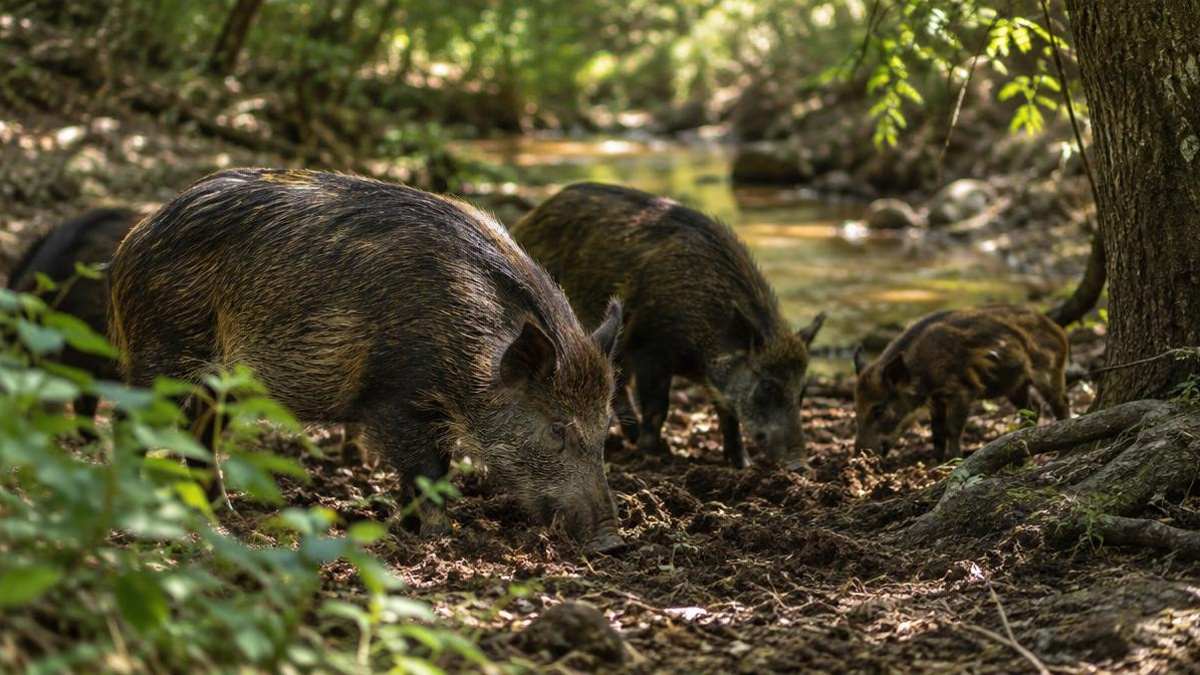
Creek bottoms have several things that hogs typically seek in one location. That is, creek bottoms have lots of shade, and softer ground than upland areas. Animals can travel through the bottom of a creek and use concealed travel routes. Also, if there is wet ground in a creek bottom, hogs can obtain water or damp ground. The best observation point may not necessarily be closest to the wettest part of the creek bottom. A hog may use the bottom as a travel corridor and then go into the brush, a field edge or to a secluded wallow. Look for bends, crossing points, openings in the vegetation and points where the bottom narrows. Look for repeated use of the same tracks, flattened areas of vegetation, rooting and fresh rubs. Creek bottoms can be a problem for the same reasons. Wet soil, steep banks, slippery surfaces and a dense tangle of growth can make it difficult to get to a bottom and observe safely. A bottom that is soggy after rain may see more hog activity than usual as they come to exploit the temporarily workable soil. A dry bottom may provide only some shade and cover, but no drinking water.
Brush Cover and Bedding Choices
Hogs prefer dense brush to provide security from weather, bedding, etc. and will often choose to have tangled vegetation, fallen trees, tall grass, brushy rise in area near food and water. In such areas the bedding spot can shift from hour to hour depending on temperature, wind, rain, etc., so a thicket that has been active in the past is only of value as a clue as to current location of hogs. Look for flattened vegetation, darkened soil, hair on rough stems and pathways leading into thicker cover. However, these sites can be very difficult to observe without disturbing the animals that use them and once you have entered a site, it is likely to be disturbed by subsequent hog activity. When comparing a close brush edge with a more open situation, also consider visibility and background to sign. A good view is of little use if it requires unsafe handling, is over a road, building, livestock or neighboring property. It is also governed by the landowner and current laws. ZXZX
Crop Edges and Feeding Routes
Activity can be concentrated at crop edges where palatable feed is situated next to suitable cover. In such situations hogs can enter a field from drainage channels, woodlands and shrublands, feed along edges of fields and return along similar routes. Damage at the edge of a crop does not necessarily mean that hogs are only visiting that area to feed, as the route in and out of a field can become well worn. When inspecting a field, inspect the transitions instead of just standing in the middle of the field looking for rooting, tracks and trails under the fence and mud from animal entry points. Where the vegetation has been bent towards the cover and is growing back in from the edge of the damaged soil within a narrow strip of undisturbed ground is where the animals prefer to travel. Machinery, animal movement, trucks, dogs, etc. could impact the timing of animal activity moving to less used areas or even going out at night in an attempt to avoid humans. Look at field edges with recent sign for the closest cover. Compare that to the cover just downfield. The attraction to food may be dwarfed by the animals’ preference to travel under cover and use a specific route.
Water, Weather and Changing Sign
Notes on water and bedding cover. A stock tank, pond, seep or shady low area may receive use during hot, dry weather. But cooler or wetter weather may see use spread across the entire ranch. Mud at water sites can indicate visits but rain will wash out older tracks and create the appearance of new use for a time. Wind, temperature, cloud and rain can all affect animal movement and sign. Look at the relationship between food, cover and water after a weather change and revisit old routes in favor of new ones. A dry creek crossing can become very useful after rain. A muddy wallow becomes less central when there is plenty of other wet ground around. Fresh tracks of humans, fencing, hunting, construction or a lot of cattle can also cause animals to move away from areas where they are used to cross through familiar openings. However, they do not have to have left the property and can be using thicker cover, a different crossing point or even another boundary on the property.
Choose Access With Safety in Mind
Know the boundaries of the ranch area before entering it, including concerns with animals, gates, roads, structures, and neighboring properties. Communicate clearly with everyone involved, determine the best locations for observation and outline the safe directions and no-shoot areas before conducting sign checks or firearm use. Walking into the midst of bedding cover to recheck signs of animals is generally not a good idea, as it will disturb animals, cause damage to the plants and later make observations very difficult. Use binoculars, maps, existing roads, etc. as appropriate. If visibility, identification, or background are questionable then it is best to move on to another opportunity rather than try to make a difficult observation. Creek-bottoms would typically be observed following travel routes through cover, crop-edges would be observed where feeding damage has been found and protected approach routes followed to the sign, and water would be observed when use of the water by hogs is concentrated due to heat etc. but detected sign would likely be stronger elsewhere on the property.
Field Checklist for a Better Decision
- Identify nearest sites for food, water and bedding.
- Follow this route and avoid entering excessive amounts of sensitive cover.
- Compare the fresh sign with the surrounding terrain, recent weather and recent disturbance.
- Check all creek crossings, brush openings, crop edges and fence lines.
- Decide whether the sign indicates hogs are going for food, water, or bedding.
- Verify safe backgrounds, property boundaries, animal locations, and no-shoot zones.
- Comply with current laws, land owner requests and range officers while patrolling.
- Recheck your plan in case of changing weather, wind, human or animal activity, changed access etc.!
- Leave uncertain identification or unsafe angles alone.
Let Conditions Set the Plan
Texas ranch habitat rarely has a single permanent answer. Texas hogs are known to travel between creek bottoms with abundant food and cover, thick brush, crop edges where hogs feed and water. The best sign can become obsolete shortly as habitable areas change. The signs are a current report of what is occurring in the habitat and must be tested against the habitat’s current state and physical features. Best option for ranch guests is a reasonable combination of useful observation with minimal disturbance and adequate safety. There is no need to promise a harvest in order to make good field judgment worthwhile. Read the ground, respect the property, and when the ranch tells you you’re wrong, change.