
Hunting Gear
Essential Gear for Texas Predator Hunting
May 8, 2026 • Lone Star Varmint Hunts
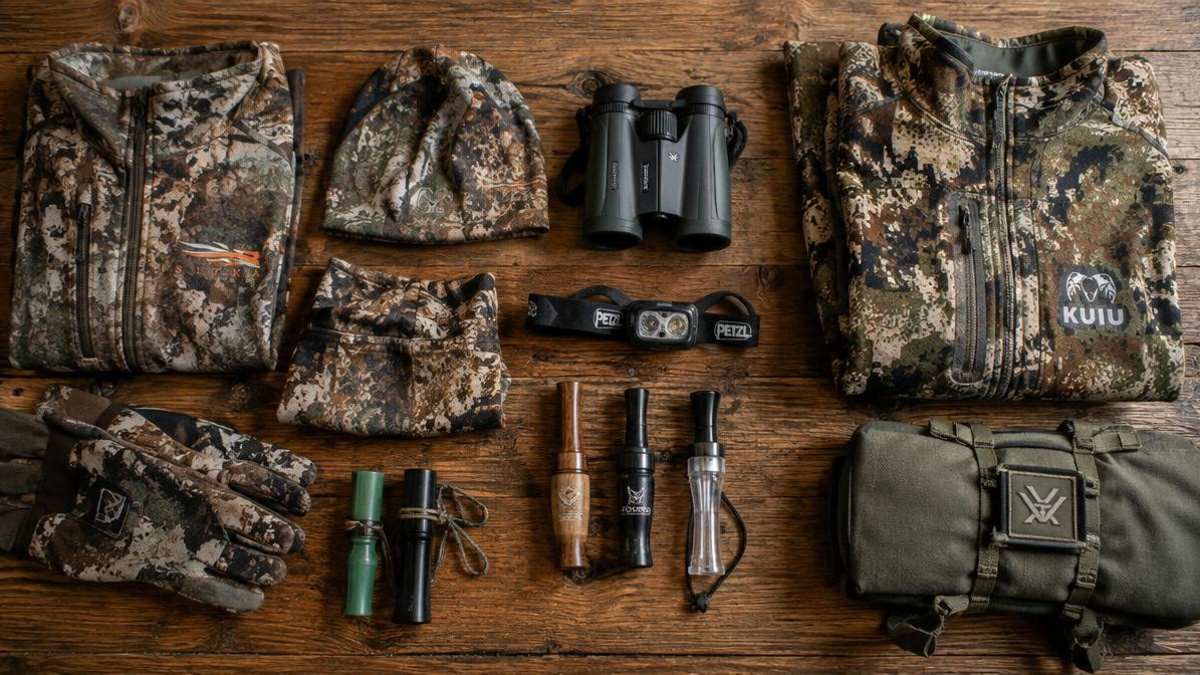
Whether you hunt small predators on public land or ranchland, the gear you take to the stand should be such that to forget a rain shell, dead batteries for your optics, and noisy clothes can turn a straightforward hunt into a long, hard, exercise. We are dealing with rough country in unpredictable weather. Texas hunting conditions generally are expected and magnified, so gear up with the best clothes, optics, protective gear, communications, and storage for each piece to ensure that all is ready for you when you need it.
Dress for wind, brush and changing temperatures
Why layering works for Texas hunting. The environments change dramatically on many Texas ranches – from cool shady areas to full sun, even heat. And the walks to your stand can be slow and stiff – only to be whipsted by a strong wind as you arrive. So instead of bringing a single bulky coat, go with a quiet base layer, and then mid-layer that’s breathable, and then finally a wind/rain shell. Look for clothing that allows for freedom of movement and that is relatively quiet. Avoid clothing with stiff fabric, loose straps or loud closures. Brush-resistant trousers, comfortable boots and socks that wick moisture are more valuable than expensive special garments with unneeded features. A good hat with a brim can provide shade as well as light rain protection. Gloves should enable safe use of equipment and not just look tactical. Consider packing a spare insulating layer in a dry bag or separate part of your pack in case of unexpected weather, as the additional weight will be worth it for a compact and useful outer layer. Do not rely on cotton as your sole insulating layer when wet and windy weather is forecast.
Select optics that match the country
Good hunting optics do not have to be complicated. They should provide a good view, remain set, be easy to focus and still be useful when light changes. For a ranch guest, binoculars are probably one of the first real pieces of hunting gear that he will use. This allows him to scan for cover far away without having to move his head or bring out his main aim instrument. When a hunt involves a firearm, choose the appropriate scope or sighting equipment for the specific firearm involved, check it to see that it is properly attached, and get familiar with how to use it prior to going out onto the landowner’s property. Use this advice for informational purposes only and do not attempt to put it into practice. Get additional information on how to properly use various pieces of equipment from a qualified range officer or firearms instructor. As for storing your accessories, storing your lens caps, soft cloth for cleaning your lenses and extra batteries in the same pouch for your camera is best. Although small bits of dust or even fingerprints on your lenses may seem insignificant, in low-contrast situations against grass or cedar for example, they can make the animal disappear from view. Magnification is not necessarily better. While it does enable you to get a better look at your subject, more magnification equals a smaller field of view and therefore also makes it more difficult to locate moving animals. The weight of more magnification also needs to be taken into account.
Protect hearing and vision before the first stand
In my opinion, eye and ear protection are amongst the easiest items to leave in your vehicle as they do not seem as important as a hat, jacket or scope. However, certified eye and ear protection must be available whenever you are handling, loading, moving or shooting a firearm. Their use is governed by current laws, range procedures, landowner restrictions and good safe practices. These types of protective equipment should be kept with easy access while shooting. Clear lenses are much better for low light situations, than tinted ones which can cause problems with rapid changes in shade. A good pair of hearing protection should be comfortable enough to wear all the time, fit well and be able to be recharged with a back up in case the main one fails. Before you leave the range for the day, make sure you do a simple pre-trip inspection of your lenses for cracks, check the fit, replace any worn plugs or muffs and make sure the equipment that requires batteries that you have for them are fully charged.field protection is not a substitute for safe gun handling and for shooting in a controlled environment, it’s just one more layer of protection for you.
Keep navigation, water and communication simple
As for navigation, having a phone is not enough. With familiar roads and turns to shooting areas such as a ranch, often there are turns, roads, draws, fences, and heavy cover that have to be re-traveled back to the vehicle. Having an offline map, or dedicated handheld GPS unit is highly recommended. Mark the vehicle, the gate, the shooting area stand, and all boundaries on the map that you are expected to abide by. A small compass is a very practical item to carry as a backup in case of a signal or battery failure. Bring enough water to the shooting location for the amount of time you anticipate you will spend outside in the field. Take into consideration the conditions and add extra water to the container should it be to sit for an extended period of time due to heat, wind, etc. A durable water bottle or hydration system is far better than some flimsy container that will rattle around in your pack and leak before you can get it stowed away. Let someone know where you’re heading off to from your vehicle and when you expect to return. Make sure your phone is fully charged and you’re using a good case. Take a power bank with you as well, in case your trip is longer than expected. Where signal is weak, work out an alternative method of checking in with your contacts. Approved radio’s and satellite communicators have to be carried by the hunter on trips where these will be the primary means of communication.
Build a pack that earns its space
A small repair kit is better than a second pouch of specialty hunting gear. Pack tape, cord, a basic multitool, lens cleaning cloths, spare batteries, and a headlamp with a well-protected switch. In addition to these items, be sure to include any personal medications, first aid supplies, and means to keep documents and permits dry as necessary for your trip. Test each item for a specific solution or function. If the new item is too complex to use in the field or simply a duplicate of an item already in your pack then it should be left behind. Lightweight gear only has value if it is dependable and easy to find. A pack-or-leave decision guide You pack an item for the reasons of health, of navigation, of the continued communication and of problems which are most likely to occur due to weather or equipment failure. Be sure to test any item that uses batteries, requires an app, needs to connect to anything or actually moves. Don’t take something that creates noise, adds weight, causes a huge amount of clutter or gets the user into more trouble than good in the field. Items such as these could possibly affect things like gates, atv’s, firearms, land boundaries or the ways in which you do things on your ranch. Ask before you take them.
Store equipment so the next trip starts clean
When you return from your trip, storage of your shooting gear starts now. Unload your firearms and store them safely in accordance with current law, transport restrictions, the manufacturer’s instructions and the landowner’s requirements. Store restricted articles safely so that they are out of the reach of Unauthorized persons. Ammunition should be stored separately where required by law or when it is safer to do so than storing with the firearms in the household. Make sure to dry clothing before packing it into a container and wipe any optics and metal surfaces of any dirt before storing them. Also, take the batteries out of any unused devices, and check for any food wrappers, damp straps, etc. before closing up packs of clothing and field accessories. Clothing and field accessories can be stored in a labeled bin, while optics and other electronic pieces are best to be stored in padded storage to keep them away from heat and moisture. Make a list to reset after every hunt. List what failed, what you didn’t use, what needs repair, and what you need to replace. Your pile of varmint hunting essentials will eventually become a reliable system to use on the Texas ranch you hunt on. And in the end, practical readiness to hunt varmints means nothing more than to show up with the few right items cleaned, charged, etc., and ready to use.