
Hunting Guides
What to Expect on a Guided Texas Ranch Hunt
August 12, 2026 • Lone Star Varmint Hunts
Most first guided ranch hunts have a different set of challenges for the hunter than simply finding and shooting animals. The toughest part for a novice hunter on their first guided hunt can be understanding how to prepare for the day, how to safely travel between locations, how to access different parts of the property, and how to patiently and effectively observe for animals in search of prey for the hunt even if no animals are going to be harvested.
Arrival sets the tone for the day
It starts with a short conversation prior to heading out to the field. Within this conversation confirm the meeting point, the expected time of arrival and other elements of the day’s activities. Confirm all necessary licenses or ID’s, verify any ranch specific information that was provided prior to the hunt and verify that all parties understand the day’s activities and the elements of the hunt that are part of the ranch. Be sure to have all of your gear with you, and make sure it is in working order before you leave the truck. Comfortable clothing, and sturdy hiking boots or shoes are all that you will need for a successful day of hunting varmints. Don’t forget water, snacks, sunscreen, insect repellent, and any other items that you may need to stay comfortable throughout the day. Before you leave the truck, let the guide know about any physical limitations, hearing problems, allergies or other conditions that may affect your ability to walk, sit or hear the guide over long distances. Such information helps the guide to make better decisions about your safety before you start the day’s hunt.
Safety comes before the first glassing stop
A responsible hunter will outline all of the safe directions in which to hunt as well as the proper ways to load and unload your firearm. We will also go over the proper types of personal protective equipment (PPE) as well as the safest ways to approach and retreat from a vehicle as well as other persons, livestock, etc. on the property. Finally, the hunter will be instructed on what to do in the event that another person, vehicle, etc. appears on the property. Remember that your rifle is always loaded. Keep the muzzle pointing in a safe direction at all times. Keep your finger out of the trigger guard until you are specifically told to ready your rifle. Bring eye and hearing protection to wear throughout the hunt. These should be part of your normal hunting gear. There is nothing to be embarrassed about to ask for clarification. Better a question at the truck than an incorrect assumption whilst walking out to a fence line or blind. If for any reason you become unsure of the safe route or lose sight of your guide, simply stop and clarify the situation.
Ranch access is part of the hunt
Private-land access brings its own set of responsibilities for the guided hunt. Be sure to find out if the gates must be left in the same position as when you found them. Be aware of the ranch tracks, water sources, hay feeder locations and other facilities and equipment such as goat and sheep housing. Stay on the course as designated by the guide for the guided hunt and do not take a shortcut across the cover that looks so simple from a distance. Movement through the terrain will depend upon how the guide has set up the day to allow the best views of likely cover. From a low draw to a cedar edge, rocky rise or open pasture the working guide will set up in the position that will allow for the safest view of the terrain and keep his party away from roads, buildings, other hunters, livestock and neighboring property. It is good to inquire as to how the ranch owner will be indicating the boundaries to the hunter (i.e. – the various landmarks and/or landmarks in change of light). In unfamiliar country it does look different in changing light. You want to make sure to give the ranch a lot of respect and know what the guidelines of the hunt are for that day.
Bring useful equipment, not every piece of gear
A guiding day doesn’t require you to bring lots of different gear. Suitable clothing, good walking shoes, water, snacks, sunblock, insect repellent, shooting glasses and good quality hearing protection are probably the main things to bring. Don’t forget your phone, on silent, and a good hat, light gloves and a change of light weight clothing for different weather conditions. Even if a guest brings their own gun, ask what gear the ranch guide or a supplying outfitter has brought and make sure that guest’s gear matches (e.g. the correct number of shells, the right pair of binoculars, the proper gun for the associated tag). Inspect your gear before you go out in the field and only use what you brought as instructed by your field guide. A small notebook can be useful for writing down such things as changes in the wind, clues to the game found in the habitat, the behavior of game encountered, or queries for the next guide or outfitter. Do not however use your phone for constant photography or for messaging as screen glare and constant movement can be a great distraction from your observation of the surrounding country.
Glassing is active observation
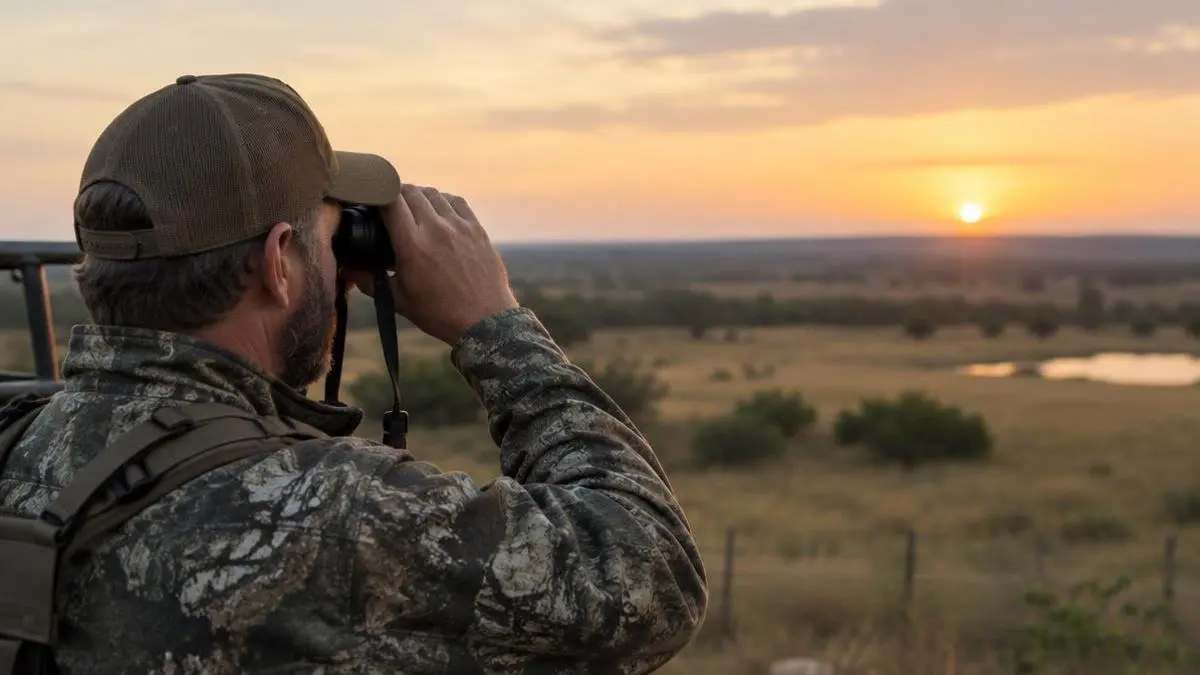
The art of glassing may appear simple yet is actively searching an area. Guides divide a pasture into sections, work from near cover to the far end of a pasture and return to an earlier location after a change in wind or light. Most importantly, there is a lot more to consider than just looking down a lens at a fence line. An informed hunter has a good idea of the influences that can affect a hunt in terms of weather, terrain, animal behavior, etc. While on the hunt the guide will take these into consideration when deciding where to move in order to give his clients the best opportunity for a successful day’s hunting. Don’t make the false assumption that you can positively identify animals seen through binoculars. Rather note such things as movement near a fence line, a speck of color, animals entering cover or things that don’t belong in the background. The guide can then make the appropriate identification or take the action needed for your safety.
Simple communication keeps everyone coordinated
Find out what simple signals the guide would like you to use for different circumstances prior to your departure from the vehicle. For example, the guide would like you to use a quiet verbal call of “movement” followed by “where” to indicate where you saw the movement, a simple hand signal to indicate that you need to move to a different location or to drink some water, or a radio call to inform the other hunters and/or guide that you have seen movement. Simple communication between hunter and guide on what type of animals are being seen, the location, and the distance helps keep the day on track. Reporting merely ‘movement’ helps the guide determine what type of action to take next. Reporting ‘unknown’ direction or distance is just as acceptable and is better than incorrectly reporting animals. Remember silence has its place but in terms of communicating in the field do not use silence when safety of the group is in question. Inform others when unsure and let the guide decide the best course of action for the group as a whole.
A guided day moves in phases
One thing to expect is frequent stops to glass, which can be very stationary but that is the nature of this type of hunting. The duration of time that you are walking can vary from a short 100 yard walk to a very long walk down a fence line and then you may set up and glass for a long period of time and then reposition. A guided hunt can sometimes not produce any results at all. However, the land that you hunt can sometimes teach a person so much on how the cover, weather, and animal disturbance affect the game’s activity. The hunt can change at a moment’s notice, such as when a change in wind, a change in cloud cover, livestock enter into the area, etc. A good guide will adjust accordingly to ensure everyone’s safety. Stops in the field are when you can take time to replenish your water, change your socks, reload your hearing protection, or re-zero your scope. The transitions from a glassing position to moving to another location are perhaps the most alert times of all.
Before you leave the ranch
Make sure that all of your own equipment has been loaded and that you are following all of the rancher’s instructions for unloading, storage and clean up. Make sure to close all gates to the ranch as you found them, and don’t leave any personal trash about. Remember that you are on private property and be sure to act accordingly. Remember that the goal of a first time guest on a guided hunt is to have a successful day of hunting as well as gain insight into how the day was run, the reasons for movement, and the signs that the country holds for future hunts.